AI-powered coding assistants have evolved in a short time from simple autocomplete tools into systems that independently modify, test, build, and run code. This shift - from prompting individual lines of code to "agentic" workflows in which AI acts as an active peer programmer in the development process - raises new questions for teams: which roles should AI sensibly take on, how do you keep control over code quality and architecture, and how does a team build this knowledge in the first place?
Letsboot has been working on exactly this transition for some time and has expanded its course portfolio accordingly.
A Broad Portfolio for Different Roles
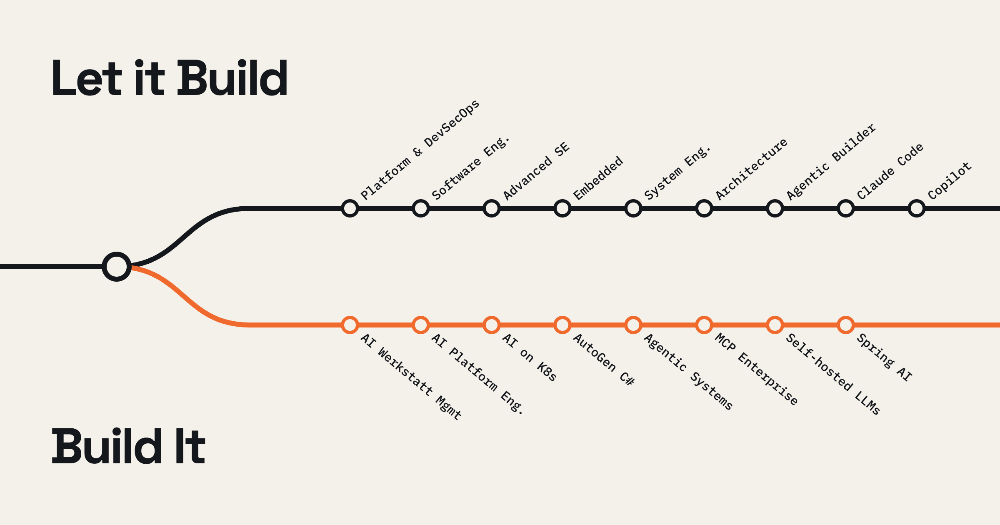
The offering in the "AI, ML & Agentic Engineering" area is now organized into two focus areas. The first, "Let it Build", is aimed at people who develop themselves with agentic tools: from the foundational course "Agentic (AI-Assisted) Software Engineering" through an Advanced level for experienced teams, to specialized formats for Platform and DevSecOps Engineering, System Engineering, Embedded Development, or Software Architecture. This is complemented by tool-specific courses, such as on Claude Code or GitHub Copilot in an enterprise context, as well as the end-to-end workshop "Agentic Builder", in which a SaaS product is built from the ground up.
The second focus area, "Build It", is dedicated to building and operating AI-based systems themselves: topics such as Building Agentic Systems, MCP for Enterprise AI Integration, Platform Engineering for AI Applications, running AI workloads on Kubernetes, or operating self-hosted LLMs are aimed at platform teams and AI developers. The workshop "AI Lab for Tech Management" also provides, without requiring any programming, a practical understanding of how agentic systems work and where they can be usefully deployed within a company.
A Building Block for the AI Literacy Obligation
The expansion of the course portfolio comes against a regulatory backdrop that is also relevant for Swiss companies with EU ties: since February 2025, the EU AI Act has required providers and operators of AI systems, under Art. 4, to ensure adequate AI literacy among their staff. Structured training on agentic tools - including onboarding, documented course content, and an accompanying learning environment - gives companies a traceable building block toward that evidence, even if it does not cover the obligation as a whole on its own.
Onboarding: Preparation Before the First Course Day
A recurring element across the courses is a structured onboarding process. Before the course begins, participants receive a questionnaire on their experience level and specific interests, which is used to tailor the course content and exercises. For hands-on work, Letsboot provides a preconfigured development environment along with installation instructions, and the necessary AI API access is provided during the course.
After the course ends, participants retain access to the so-called Letsboot Labmachine, a learning environment in which agentic ways of working can be deepened independently. This means engagement with the topic doesn't end on the last day of the course but continues through an existing infrastructure.
Letsboot offers courses and training in software and systems engineering, with focus areas including Agentic Engineering, Backend, Frontend, and DevOps topics, as well as Security. Courses take place publicly in Zurich and Basel according to the course schedule as well as in-house. More at www.letsboot.ch.